Designing Culture+ to help engineering startups build inclusive, innovative cultures
Culture+ is a company culture and behaviour change tool built for the Royal Academy of Engineering. Founders and leaders wanted to build inclusive cultures but didn't know where to begin, and the resources they had tried hadn't helped them see impact. I led the design with an experiment-driven approach from research to launch, creating a honeycomb of bite-sized learning cells and habits people can practise in their daily work.
Context
Helping engineering startups build inclusive cultures
The Royal Academy of Engineering is the UK's National Academy of Engineering, harnessing engineering to build a sustainable society and an inclusive economy that works for everyone. It also supports engineering startups through leadership training, grants, fellowships, networking and accelerator programs.
The challenge
In a 2023 research study of 1,657 participants in the engineering industry, the Academy found that only 50% of respondents agreed the work culture of the engineering sector had changed over the past five years, and 53% of those believed it had worsened a little.
- Yes 50%
- No 31%
- I can't comment 11%
- I don't know 9%
The Academy began a project focused on engineering startups and scaleups, asking:
How do we help engineering startups and scaleups create inclusive cultures that foster innovation?
The Royal Academy of Engineering's project questionResearch
Understanding the people I was designing for
I conducted exploratory user research to understand the people I was designing for: their context, needs, motivations and pain points. It also built empathy across the team. We were a team of 3 researchers.
Methodology
-
10 semi-structured user interviews
-
2 focus groups, 60 minutes each
-
Desk research (analysing previous research)
-
2 discovery workshops with stakeholders and partners
Participants
Engineering startups and scaleups: founders and co-founders, senior leaders, engineers, non-engineers, board members and consultants.
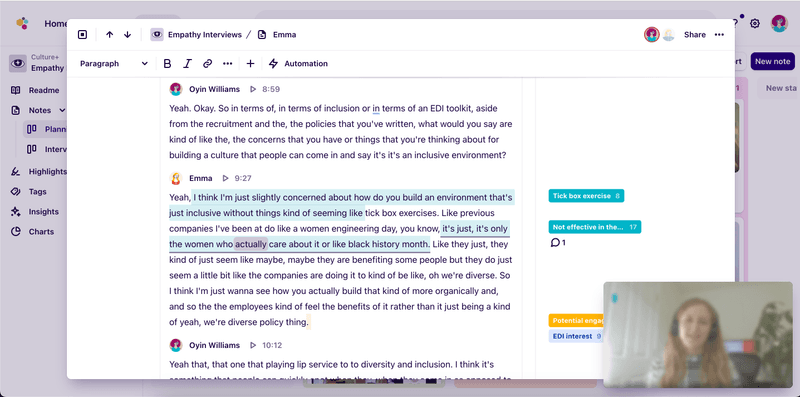
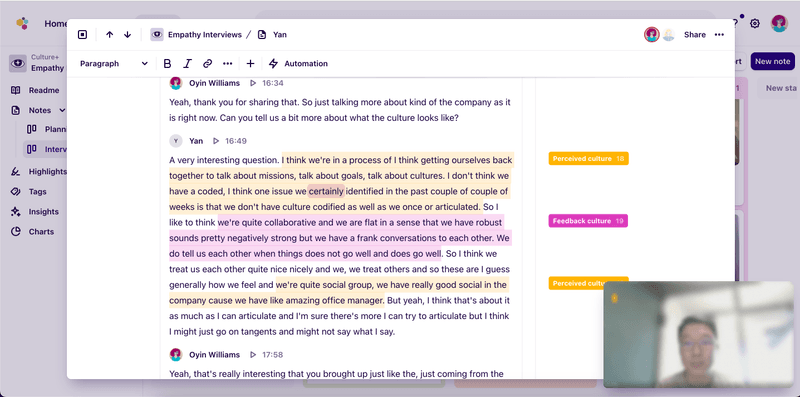
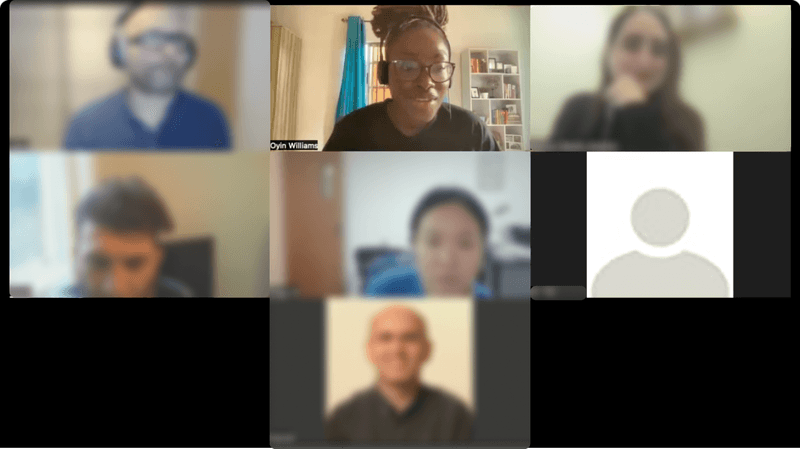
Key findings
-
Engineering startups are fast-paced and changing, so time is a valuable resource.
-
Startups have a high perception of their culture with no clear evidence to support it beyond "vibes".
-
Diversity in recruitment is a perceived challenge engineering startups face in their culture.
-
People have not found previous resources effective in helping them see impact.
-
Founders and leaders intend to build inclusive and diverse work cultures but don't know where to begin.
-
The majority of startups had no proper structures or processes for people and culture management.
Insights
From research data to personas and themes
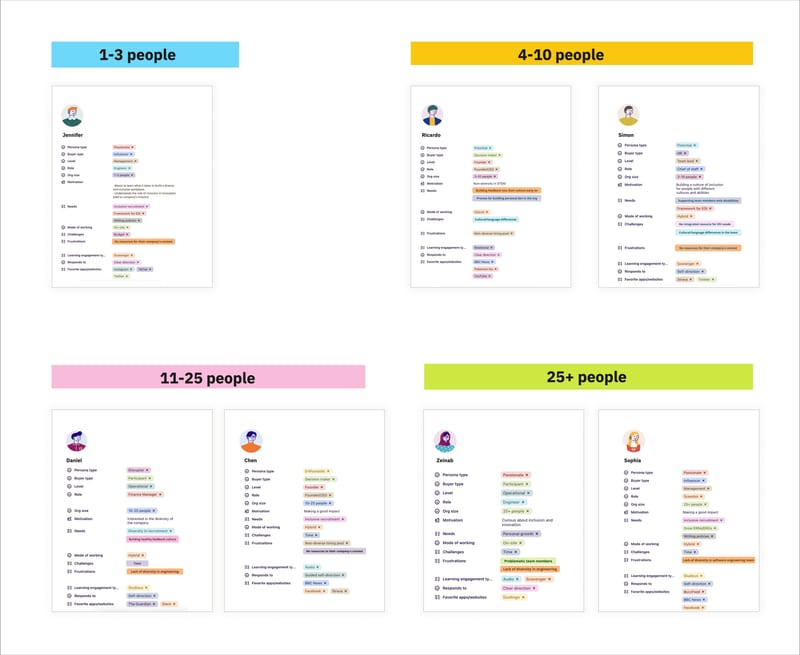
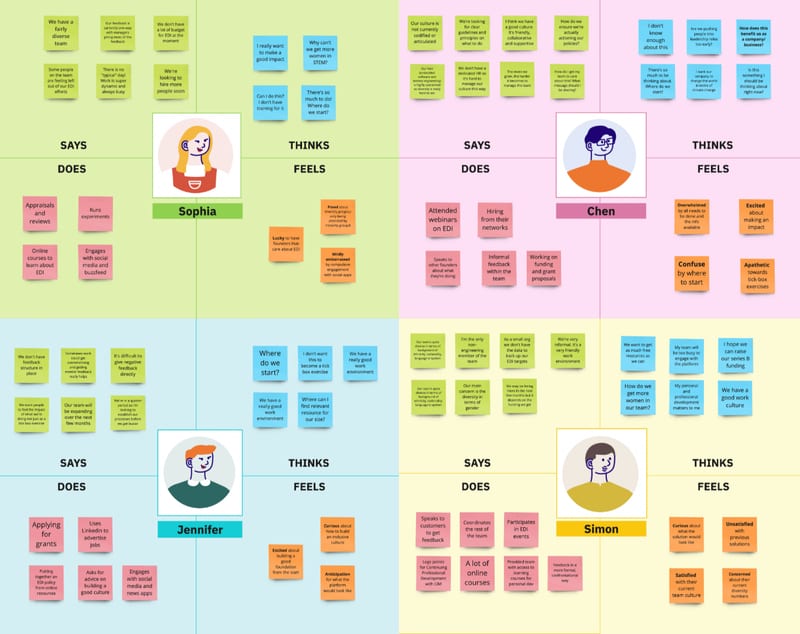
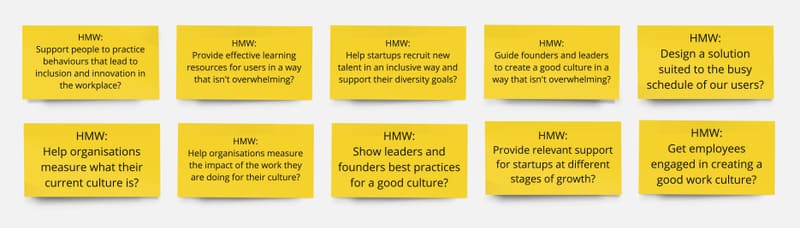
I synthesised the data into personas, empathy maps, use cases and a how-might-we framework. User behaviours depended heavily on a startup's growth stage, so the personas are segmented by company size (1-3, 4-10, 11-25 and 25+ people).
Five themes, three prioritised for the MVP
Behaviour change
Help individuals build inclusive and innovative habits within their daily workflow, moving beyond tick-box exercises.
Learning content and resources
Relevant, bite-sized content that fits busy users' context.
Recruitment support
Inclusive recruitment guidance, both a user need and an immediate business opportunity.
Explored after the MVP
Organisation EDI resources
Guide leaders on writing EDI policies and answer "Where do I begin?"
Impact measurement and diagnosis
Diagnosis and progress tracking.
Process
An experiment-driven, triple-diamond process
I took an experiment-driven approach using the triple-diamond process: Diamond 1 Research (Understand), Diamond 2 Proof of concept (Experiment), Diamond 3 Build and test (Develop).
-
Research
Diamond 1: Understand
- Brief
- Research
- Insight
-
Experiment
Diamond 2: Proof of concept
- Define
- Ideate
- Validate
-
Deliver
Diamond 3: Build and test
- MVP
- Complete
- Analyse
- Culture+
Ideation
Hypotheses, principles and three design options
Hypotheses
Self-directed learning that doesn't force a linear path will encourage engagement.
Specific, observable actions and habits in each learning module will make behaviour change easier and more effective.
Self-assessments will give room for reflection and more self-awareness of behaviours.
Anonymous feedback will let people share feedback safely and comfortably.
Recruitment support features will drive more engagement.
Design principles
-
Make it obvious
Show people exactly what to practise to become inclusive and innovative.
-
Make it easy
People are busy, so the design must be easy to understand and navigate.
-
Make it attractive and satisfying
Let people see their journey at a glance without a linear path.
-
Make it impactful
Always consider the impact on users, both positive and negative.
I worked with behaviour scientists, DEI consultants and learning design experts.
Design options
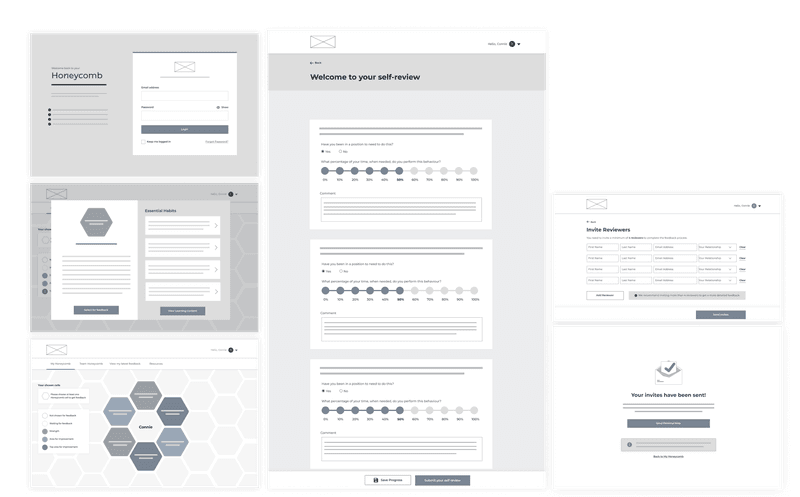
The learning modules (cells) were mapped into the existing Honeycomb design framework, each cell made of 4 essential habits that indicate strength or a need for improvement.
All cells clustered together, each connecting a similar topic.
Cells clustered in 3 focus areas, each cluster separate.
Cells clustered in 3 focus areas, each cluster connected with an empty cell.
What we tested
-
People would prefer Option C for ease of navigation.
-
People would find the content relevant and useful.
-
People would want to start asking for feedback on the habits.
Validation
What testing showed
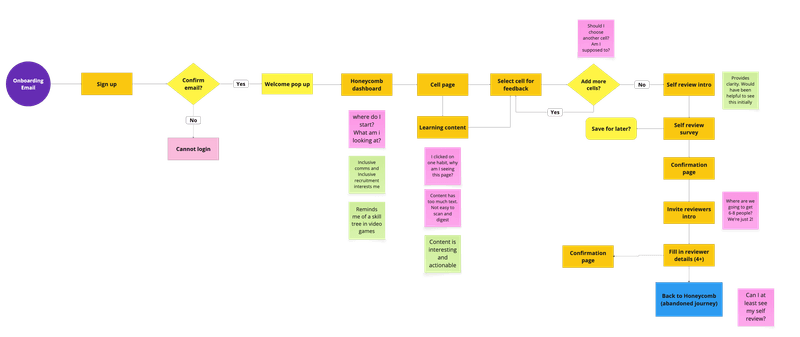
All designs had navigation flaws
They were initially challenging to navigate, and users were uncertain what actions to take, so they needed more guidance. Option A was the least preferred.
Users will benefit from more personalisation and a tailored journey
71% of users struggled with knowing what to focus on and what applied to them, and they asked about the differences across roles and organisations.
People find the content relevant
Users found the platform relevant, and all of them showed interest in specific cells they wanted to explore further.
Solution
One honeycomb, and an onboarding checklist
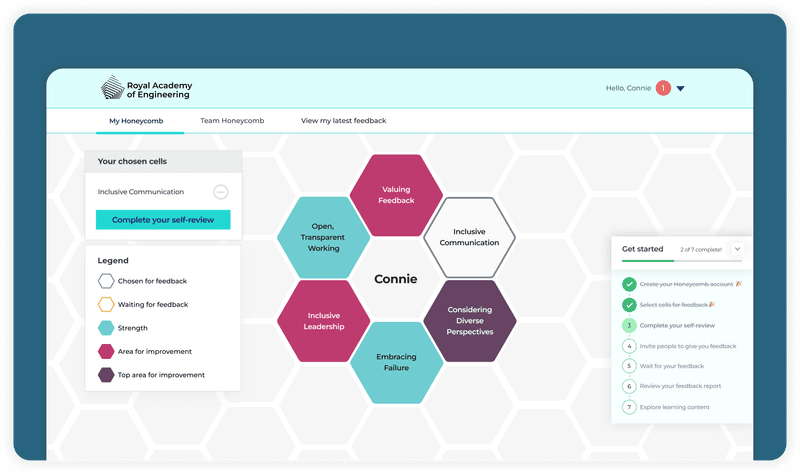
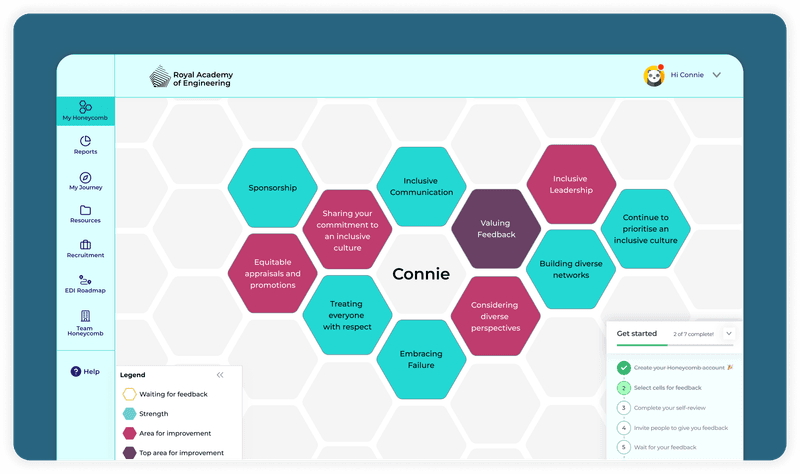
I removed the focus-area sections and condensed all the cells into one honeycomb. Removing the extra information made the interface more focused and less overwhelming.
Final designs
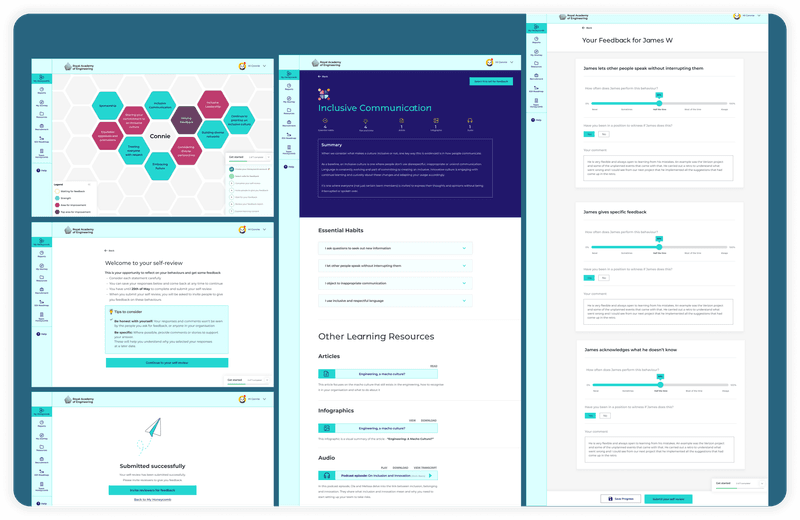
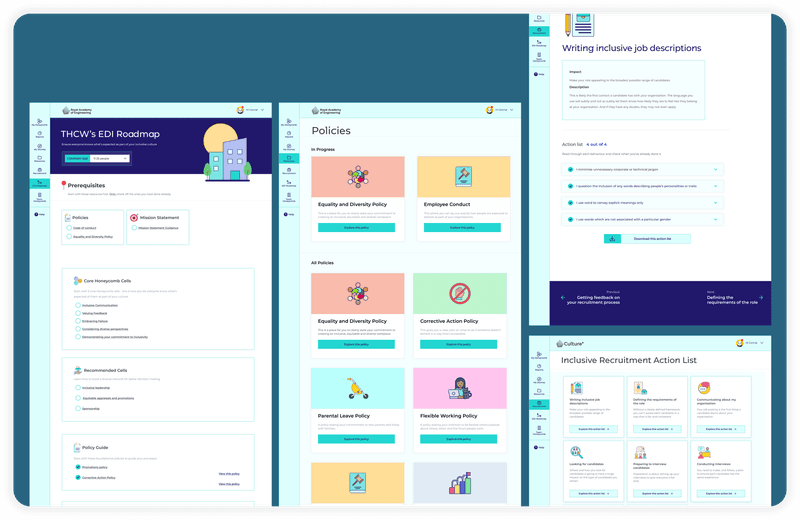
Full tour
Impact
Culture+ at launch
- Of the behaviours an organisation focused on improved within 12 months of using Culture+
- 85%
- Rise in their inclusive communication score, from their top area for improvement to their top strength
- +7.4 pts
- Engineering startups onboarded onto Culture+ by the end of the pilot
- 70+
- In the press: Startups Magazine Royal Academy of Engineering launches Culture+ to boost EDI in engineering startups (opens in a new tab)
Learnings
What I'm taking forward
User behaviour over user intention
Put more weight on what people actually do than on what they say, which is crucial for behaviour change, because people often tell you what they wish they did.
Question everything
We went in with many assumptions, and questioning them and experimenting as we went let us learn quickly and arrive at solutions with impact.